Do teens who use AI for companionship really face the highest rates of suicidal thoughts?
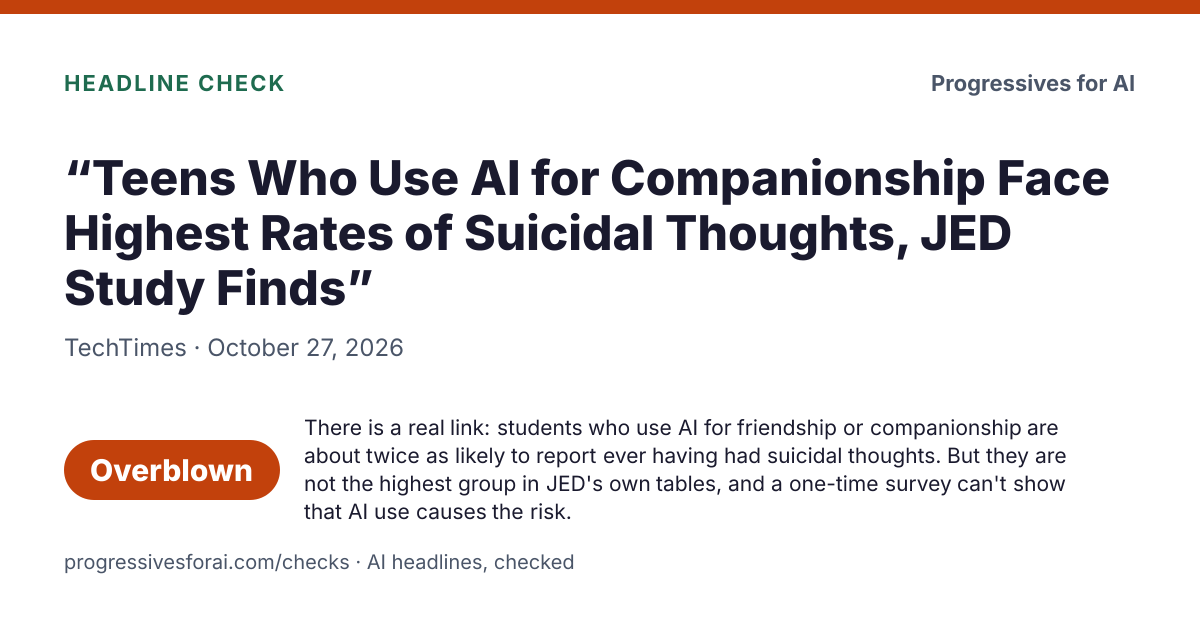
“Teens Who Use AI for Companionship Face Highest Rates of Suicidal Thoughts, JED Study Finds”
There is a real link: students who use AI for friendship or companionship are about twice as likely to report ever having had suicidal thoughts. But they are not the highest group in JED's own tables, and a one-time survey can't show that AI use causes the risk.
01The short version
- JED surveyed 5,560 middle and high school students in 21 U.S. schools. Those who use AI as a friend or companion (12% of students) were about twice as likely to report a lifetime history of suicidal thoughts.
- It is a one-time survey, so it cannot say whether AI made things worse or struggling teens turned to AI. JED says so itself.
- The word "highest" is shaky. Students who use AI to get help when sad or stressed show a bigger gap, and using AI for any reason overall showed no significant link.
If you or someone you know is struggling, you can call or text 988, the Suicide & Crisis Lifeline (US), any time.
02Where the claim came from
On October 27, 2026, TechTimes ran a story saying teens who use AI for companionship face the highest rates of suicidal thoughts.3 It was based on a new report from The Jed Foundation (JED), a youth suicide-prevention nonprofit. NPR covered the same report three days later.2
JED’s report is a survey of 5,560 middle and high school students in 21 U.S. schools, collected between October 2025 and April 2026. Students were asked why they use AI, and how they feel. The data were adjusted for sex, race and grade. The sample is not nationally representative.1
03What the evidence actually shows
04Check our sources
Every source below was read by two AI models separately, Claude Haiku and ChatGPT, to confirm it says what we say it does, and we re-check each link every month. Open any of them and see for yourself. How we check sources
- The Jed Foundation (JED) · Oct 2026
Exploring Artificial Intelligence [AI]: Understanding Relationships between AI Use and Mental Health Among Middle and High School Students
What it backs upJED reports the most consistent links to worse mental health, including a greater lifetime history of suicidal thoughts and attempts, in two groups: students who use AI for friendship or companionship, and students who turn to AI when sad, stressed, lonely or overwhelmed.
“The most consistent findings were among students who used AI for friendship or companionship, or who sought help from AI when feeling sad, stressed, lonely, or overwhelmed.”
Open source (opens in a new tab)- Checked by Claude Haiku · Nov 3, 2026 · Supports
- Checked by ChatGPT · Nov 3, 2026 · Supports
- Monthly re-check not run yet
- NPR · Oct 30, 2026
Nearly 2 out of 3 teens and tweens use AI chatbots, new research shows
What it backs upJED's vice president of research and evaluation says the data cannot show whether AI use contributes to poor mental health or whether students already in distress turn to AI.
“unclear, based on these data, whether AI use is contributing to poor mental health and well-being, or whether students who are already in distress in certain ways are more likely to turn to AI”
Open source (opens in a new tab)- Checked by Claude Haiku · Nov 3, 2026 · Supports
- Checked by ChatGPT · Nov 3, 2026 · Supports
- Monthly re-check not run yet
- TechTimes · Oct 27, 2026
Teens Who Use AI for Companionship Face Highest Rates of Suicidal Thoughts, JED Study Finds
What it backs upThe TechTimes story says companionship users had the worst outcomes by a significant margin compared with every other use category.
“the worst outcomes by a significant margin appeared among the 12% of students who used AI specifically for friendship or companionship”
Open source (opens in a new tab)- Checked by Claude Haiku · Nov 3, 2026 · Supports
- Checked by ChatGPT · Nov 3, 2026 · Supports
- Monthly re-check not run yet
- OPB (NPR story) · Oct 30, 2026
Nearly 2 out of 3 teens and tweens use AI chatbots, new research shows
What it backs upA separate study by University of North Carolina researchers, not yet published, found that middle schoolers who use chatbots for companionship grew lonelier over time.
“In a soon-to-be-published study of middle schoolers in one state, Maheux and her colleagues at UNC found that students who use chatbots for companionship grew lonelier over time.”
Open source (opens in a new tab)- Checked by Claude Haiku · Nov 3, 2026 · Supports
- Checked by ChatGPT · Nov 3, 2026 · Supports
- Monthly re-check not run yet
- Brown University School of Public Health · Nov 18, 2025
One in eight adolescents and young adults use AI chatbots for mental health advice
What it backs upIn a nationally representative 2025 survey of young people aged 12 to 21, about one in eight said they use AI chatbots for mental health advice.
“About one in eight U.S. adolescents and young adults in the U.S. are turning to AI chatbots for mental health advice”
Open source (opens in a new tab)- Checked by Claude Haiku · Nov 3, 2026 · Supports
- Checked by ChatGPT · Nov 3, 2026 · Supports
- Monthly re-check not run yet
05What the headline gets right
The study exists and says roughly what the headline says. Students who used AI for friendship or companionship had more anxiety and depression, more loneliness, lower resilience, and a greater history of suicidal thoughts and attempts than students who did not use AI that way.1 A gap of about two to one is large. JED’s authors call these among the most consistent findings in the report, and they ask companies to keep AI companions away from minors.1
It is also not a one-off. An early, unpublished study from the University of North Carolina found middle schoolers who used chatbots for companionship grew lonelier over time.4
06What it gets wrong or leaves out
“Highest.” Companionship is not the top group in JED’s tables. Students who turn to AI to get help when they feel sad, stressed or lonely show a bigger gap for suicidal thoughts (2.43 against 2.01) and for attempts. Some reasons within that group, such as having no one else to talk to, are higher still.1 JED itself groups the two together as its most consistent findings.1 The TechTimes story says companionship was worse than every other category “by a significant margin,” which JED’s tables do not show.3
“Face.” The headline reads like a forecast: use AI this way and this is what you will face. The survey is a single snapshot. Kayla Anderson, JED’s vice president of research and evaluation, says it is unclear whether AI use contributes to poor mental health or whether students already in distress are more likely to turn to AI.2 The report says the same, and says the sample is not nationally representative.1 To its credit, the TechTimes story repeats that caveat further down the page.
“Rates of suicidal thoughts.” The measure is a lifetime history of suicidal thoughts, not current thoughts. A teen who had such thoughts years ago counts.1
What is missing. Using AI for any reason was not linked to worse mental health overall.1 The finding is about how teens use AI, not whether they do.
07Where the real concern is
Many teens already turn to AI when they are hurting. In JED’s survey 57% of students used AI when they felt sad, stressed, lonely or overwhelmed, though only 8% said they were using it to “get help.”1 A separate nationally representative survey found about one in eight young people use chatbots for mental health advice.5
Whichever way the link runs, some teens who are struggling are reaching for a product that was not built or tested for that job. That is a design and oversight question for companies and lawmakers, and it does not depend on proving the chatbot caused the harm.
08What we’re not sure about
Direction. We do not know whether companionship use worsens mental health, whether struggling teens seek companions, or both. Tracking the same teens over time would answer it, and the UNC study that does so is not yet published.4 We also have only JED’s report and its own tables: it has not been through outside peer review, and the survey could not account for how a student was doing before they started using AI.
09The progressive move
Press for independent safety testing of AI products that teens use, and for rules that keep companion-style products designed to build attachment away from minors, which is JED’s own ask. Fund the human supports, such as school counselors, that struggling teens turn to AI in place of.
Talking points — ready to paste
- JED's survey found teens who use AI for friendship or companionship were about twice as likely to report ever having suicidal thoughts.
- It is a one-time survey. JED says it cannot tell whether AI made things worse or struggling teens turned to AI.
- Using AI for any reason showed no significant link overall. How teens use it, especially when they are struggling, is what matters.
What changed
Spot a mistake? Tell us and we'll fix it in the open, with a note here.